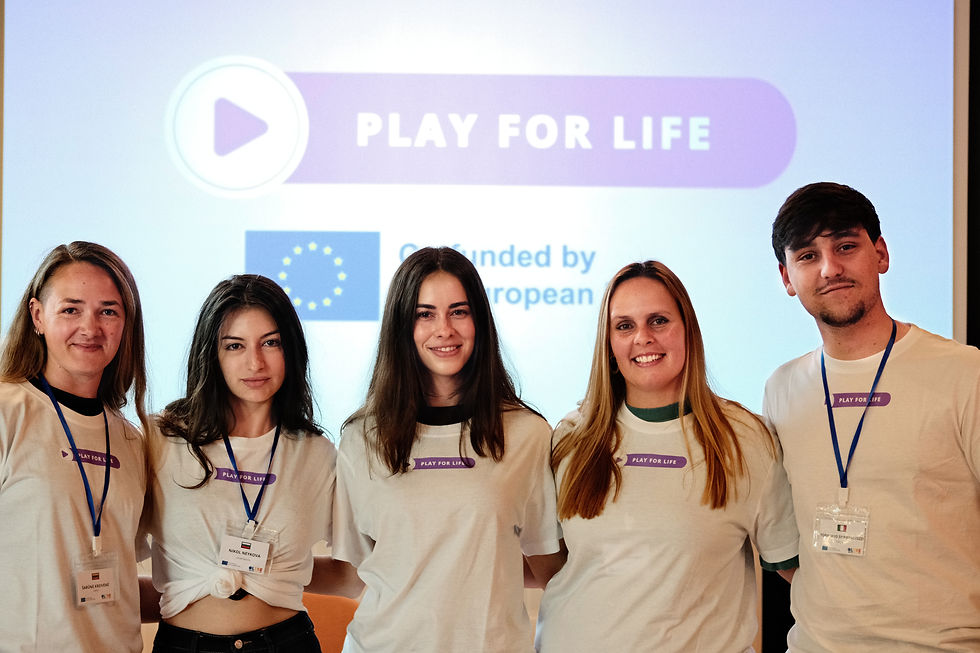
Play for Life in Bucharest: the second transnational meeting strengthens the educational role of sport youth workers

In September 2026, the partners of the Play for Life – PFL project met in Bucharest, Romania, for the second Transnational Meeting of the project.
The four-day meeting brought together five participants from each partner organisation, involving representatives from ASD Passaggi nello Sport (Italy), ATIC (Romania) and Sportsroom (Bulgaria).
After the first Transnational Meeting, which focused on understanding youth addiction, prevention and the educational potential of sport, the Bucharest meeting represented a further step towards transforming the Play for Life approach into practical skills, methods and tools that sport youth workers can use in their daily activities with young people.
Sport youth workers as educational figures
One of the central activities of the meeting was the workshop “The educational potential of sport youth workers”.
Participants reflected on the fact that coaches, trainers, volunteers and other professionals working in sport are often much more than technical figures. Through regular contact with young people, they can become trusted adults, positive role models and important points of reference, especially for young people experiencing personal, family or social difficulties.
The workshop explored how sport environments can offer opportunities for learning, inclusion, responsibility and belonging, helping young people develop personal and social skills that can also act as protective factors against risky behaviours.
A second workshop focused on how to become respected educators.
Respect was discussed not as something connected only to authority, but as something built through consistency, listening, empathy, fairness and the ability to create meaningful relationships with young people.
Participants exchanged experiences from their different national and organisational contexts, identifying behaviours and approaches that can help youth workers create safer and more supportive sport environments.
Communication, collaboration and motivation
Another important part of the programme was the laboratory dedicated to effective communication, collaboration and motivation.
Working with young people requires much more than explaining an exercise or organising a training session. Sport youth workers need to know how to communicate clearly, recognise different needs, manage group dynamics and motivate young people with different levels of confidence and participation.
Through practical activities and group discussions, participants explored techniques to improve communication and strengthen cooperation within sport groups.
These skills are particularly important when working with young people at risk, as positive relationships and a sense of belonging can contribute to building trust and encouraging continued participation in healthy and structured activities.
Creating impactful graphic tools
The Bucharest meeting also included a practical laboratory on impactful graphic tools.
Participants worked on how educational and awareness-raising messages can be transformed into accessible and attractive visual materials.
Clear communication is an important part of the Play for Life approach: prevention messages need to be understandable, engaging and suitable for young people, sport organisations, families and local communities.
The activity therefore contributed to strengthening the partners’ ability to communicate project messages and support the dissemination of the Play for Life resources.
Designing innovative sport exercises
During the training session on creating innovative sport exercises, participants moved directly from theory to practice.
The objective was to explore how ordinary sport activities can be adapted or redesigned to develop not only physical skills but also cooperation, trust, communication, decision-making and mutual support.
Participants worked together to develop exercises that can be easily replicated by coaches and sport youth workers in different disciplines and local contexts.
This practical approach is particularly important for Play for Life, which aims to provide sport organisations with concrete resources that can be integrated into their everyday work rather than remaining only theoretical recommendations.
Practical tools for analysis
The programme concluded with a laboratory dedicated to practical analysis tools.
Participants explored methods that can help sport youth workers better observe group dynamics, identify needs, reflect on their activities and understand how young people respond to different educational approaches.
Developing these analytical skills can help organisations make their sport programmes more responsive, inclusive and effective.
From European cooperation to practical resources
The second Transnational Meeting in Bucharest confirmed the practical orientation of Play for Life.
The activities did not focus only on exchanging ideas between the three partner organisations. They were designed to transform shared experiences into methods, exercises and tools that can be transferred to sport organisations and youth workers across Europe.
The knowledge developed during the meeting will contribute to the project results, including the Play for Life Method, the targeted sports exercises and the practical analysis tools that will support coaches, volunteers and sport youth workers in their work with young people.
Through training, experimentation and transnational cooperation, Play for Life continues to promote a simple but important principle: sport can be much more than physical activity. It can become a space for education, trust, inclusion and prevention, where young people can build positive relationships and find support to face the challenges of their everyday lives.