🇬🇧 GENS Transnational Meeting in Rome: building inclusive sport associations from within
Aggiornamento: 14 mag
April 2026
🇪🇺 A project co-funded by the European Union

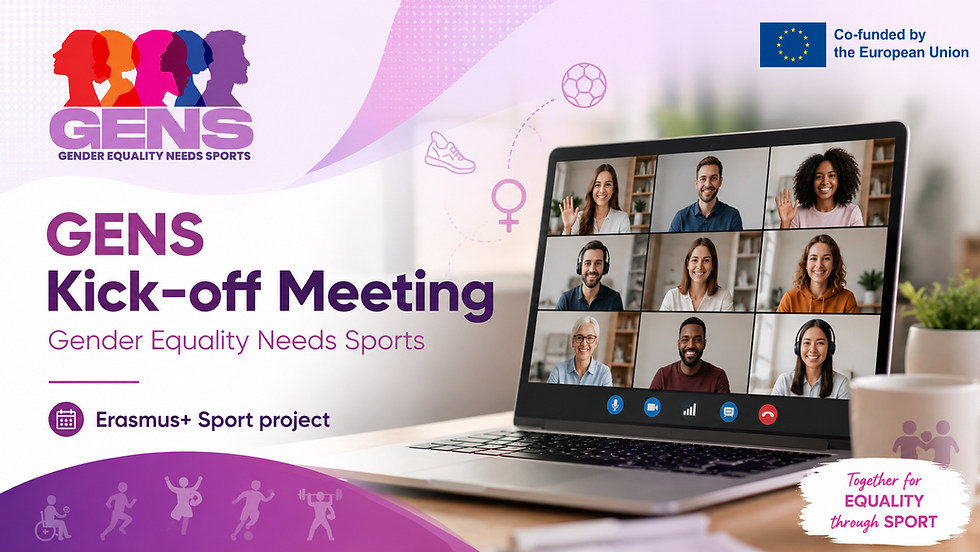
During the fourth week of April 2026, Rome hosted the first Transnational Meeting of GENS – Gender Equality Needs Sport, an Erasmus+ Sport project co-funded by the European Union.
For three days, the partner organisations came together to work on one of the main goals of the project: helping sport associations fight gender stereotypes not only during training sessions, but also at managerial, organisational and communication level.
The meeting involved representatives from all partner organisations, with 12 participants in total, 3 per partner, in line with the project structure. It was designed as a transnational working space where partners could learn, exchange experiences and start building the first practical tools of the project.
🏟️ Why this meeting matters
Sport associations are not only places where people train. They are educational spaces where young people learn values, build confidence and shape their identity.
For this reason, the way a sport association is managed matters. Internal rules, communication choices, leadership styles, the relationship with families and the way activities are promoted can either reinforce gender stereotypes or help dismantle them.
The Rome meeting focused exactly on this point: how can sport managers create organisations where girls, boys, women and men feel equally welcome, respected and free to participate?
🧠 Training: gender identity, biological sex and sexual orientation
The first activity was a training session dedicated to clarifying three key concepts: gender identity, biological sex and sexual orientation.
Participants worked on the differences between these terms and reflected on why a clear and respectful vocabulary is essential in sport environments. This session helped create a shared basis for the rest of the meeting, allowing partners to approach the topic of gender equality with more awareness and precision.
The discussion also highlighted how misunderstandings and stereotypes often come from a lack of knowledge. For this reason, sport managers need basic but solid tools to understand diversity and to communicate in a way that respects every person.
🎯 Workshop: the role of sport managers
The second activity focused on the role of sport managers in promoting equal opportunities in amateur sport.
Participants analysed how managers can influence the culture of a sport association through everyday decisions: how courses are presented, how families are welcomed, how coaches are selected and supported, how communication materials are created, and how internal policies are defined.
The workshop encouraged partners to look at sport associations from the inside, asking practical questions:
❓ What messages do we send to children and families?
❓ Do our activities feel open to everyone?
❓ Are some disciplines still presented as “for boys” or “for girls”?
❓ Do our communication choices promote inclusion or repeat old stereotypes?
This reflection helped partners understand that inclusion is not only a value to declare, but a method to apply in management, planning and daily organisation.
🤝 Best practice sharing: governance, administration and communication
A central part of the meeting was dedicated to best practice sharing.
Each partner presented experiences and examples from its own local context, focusing on three areas: governance, administration and communication.
The exchange allowed the consortium to compare different sport environments: small towns, urban communities, dance schools, youth organisations, sport clubs and educational spaces. This variety was important because gender stereotypes appear in different ways depending on the context.
Some partners shared examples connected to the idea that dance is often perceived as a “female” activity, while football is still seen as more suitable for boys. Others reflected on the importance of empowering women and girls, involving families, supporting youth workers and creating sport environments where participation is not limited by traditional expectations.
This activity helped collect concrete ideas for the first project booklet, which will focus on good practices for building inclusive sport associations.
🧩 Workshop: organisational psychology
The final thematic activity was a workshop on organisational psychology.
Participants explored how the culture of an organisation influences behaviours, relationships and expectations. A sport association can have inclusive intentions, but still reproduce stereotypes through habits, language, roles or informal rules.
The workshop helped participants reflect on how to identify these hidden mechanisms and how to introduce positive changes inside their organisations.
The discussion focused on leadership, group dynamics, internal communication, resistance to change and the importance of creating a safe environment for staff, coaches, volunteers, athletes and families.
This part of the meeting was particularly important because GENS does not treat gender equality as a single activity, but as a process that must become part of the association’s culture.
📘 From the meeting to the first project output
The Rome meeting also contributed directly to the development of the first GENS output: a booklet dedicated to sport associations and managers.
The booklet will collect definitions, practical recommendations and good practices to help sport organisations promote equal opportunities and fight stereotypes from within.
The work carried out in Rome provided the basis for several key sections of the booklet, including:
📌 gender identity, biological sex and sexual orientation;📌 basic glossary and inclusive vocabulary;📌 the role of sport managers;📌 inclusive governance;📌 inclusive administration;📌 gender-sensitive communication;📌 organisational psychology applied to sport associations.
🌍 A shared European commitment
The Rome Transnational Meeting confirmed the strength of the GENS partnership.
Each organisation brought its own experience, but all partners shared the same vision: sport should be a place where people are not limited by gender stereotypes, but encouraged to discover their talents, express themselves and participate freely.
The meeting showed that change starts from awareness, but it becomes real only when it enters the everyday life of sport associations: in the way they manage activities, communicate with families, support coaches and welcome young people.
🚀 Next steps
After the Rome meeting, partners will continue working on the first booklet and on the communication materials connected to the project.
The next phase will focus more directly on coaches, trainers and youth workers, with practical tools to promote gender equality during sport activities and training sessions.
GENS continues its European journey with a clear message:
✨ Sport should never tell someone who they are allowed to be.✨ Sport should help everyone feel free to become who they are.